The problem
Most trading journals are spreadsheets with extra steps.
The actual failure mode for discretionary traders is not information. It is execution discipline under emotional pressure. You know your rules. You break them anyway. Stop-loss is there. You move it. Position size is defined. You size up on conviction. The loss is always "the one exception."
I built LYT because I kept doing that. The system is designed to make the exception structurally impossible — and to surface, in writing, every time you almost made one.
Dashboard
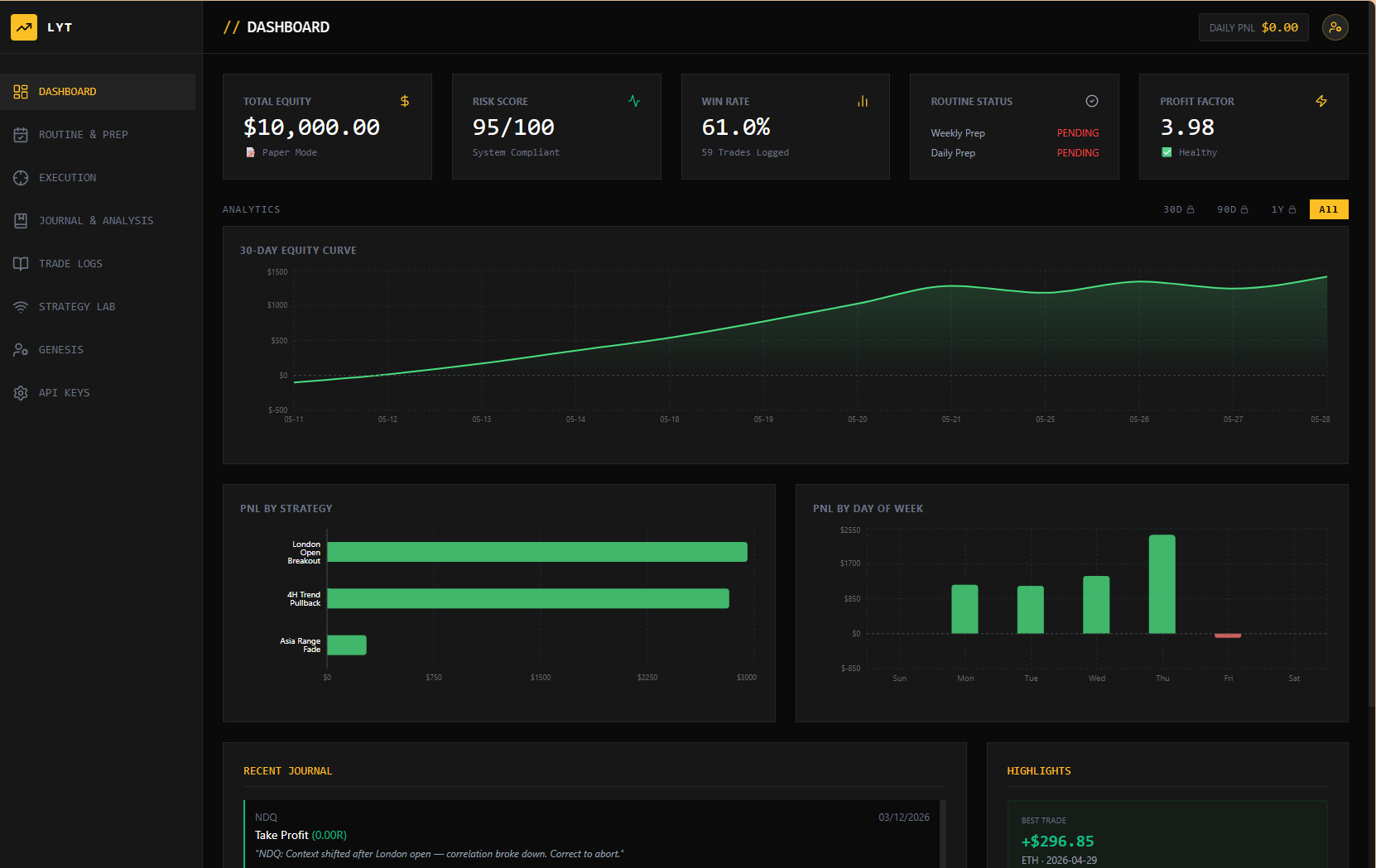
Everything in one view. Total equity, risk score, win rate, profit factor, 30-day equity curve, PNL by strategy, PNL by day of week. The risk score (95/100, System Compliant) reflects whether your behaviour matches your stated rules — not just whether you're profitable.
Strategy Lab
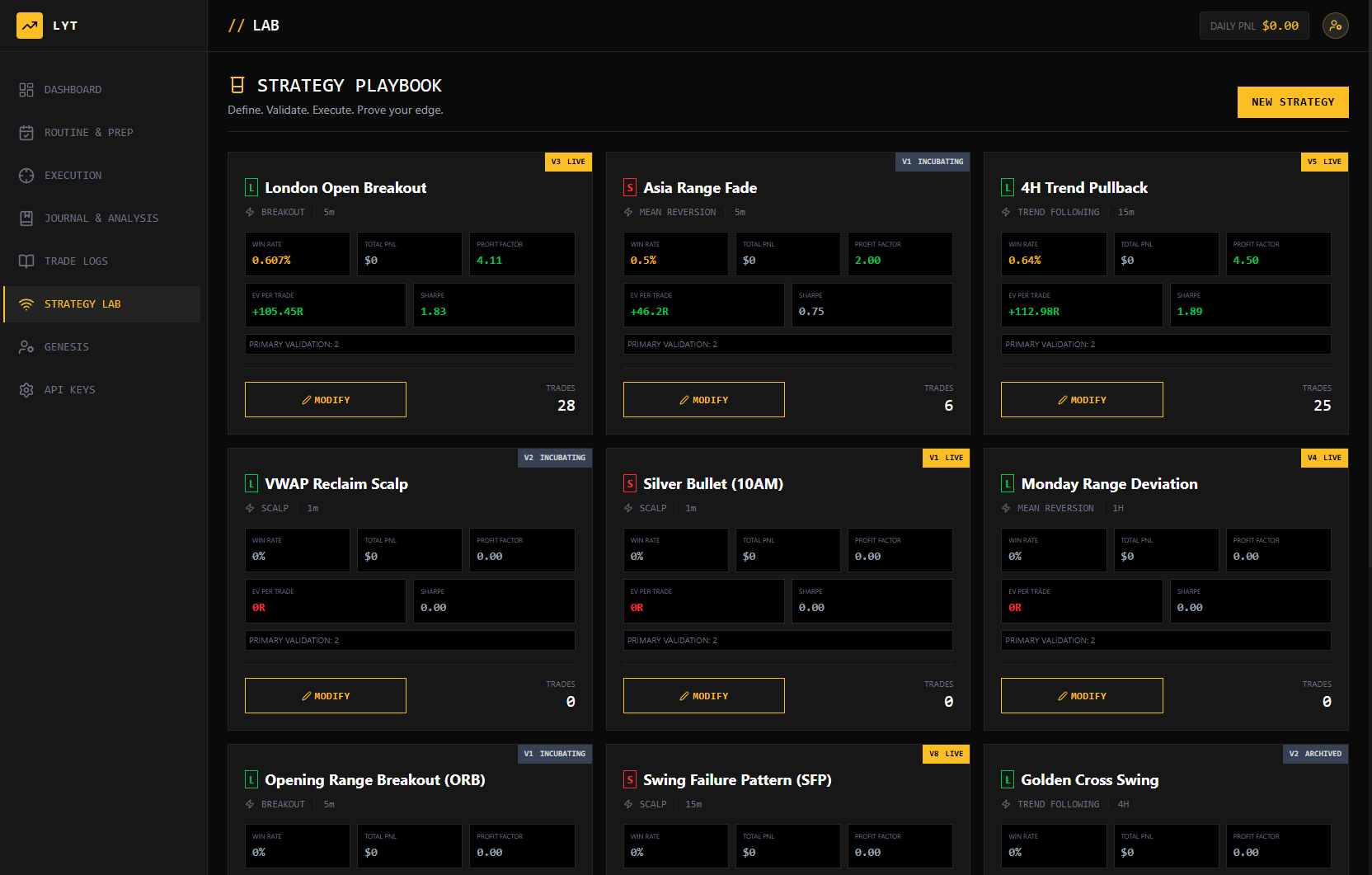
Every strategy gets a version number and a lifecycle status: INCUBATING, LIVE, or ARCHIVED. When you change your entry criteria, a new version is created. Old trades stay attached to the version they were taken under.
The result: you can compare V3 of London Open Breakout (4.11 profit factor, 28 trades, Sharpe 1.83) against V1. Without versioning, you just see a blended P&L that means nothing.
Performance tracked in R-multiples, not dollars. EV per trade, Sharpe ratio, profit factor. The same metrics a prop desk uses.
Routine & Prep
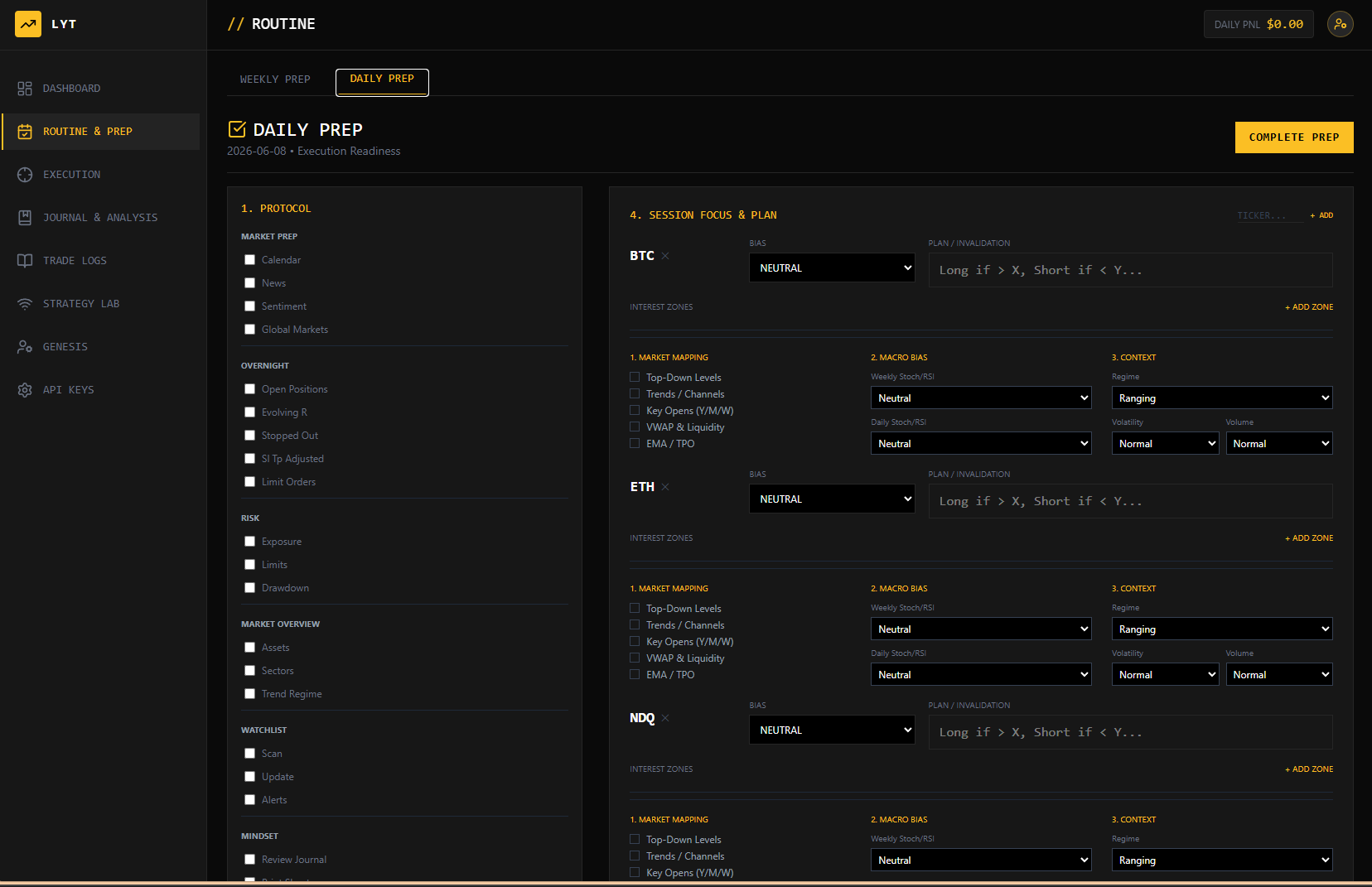
You cannot reach the execution workspace without completing daily prep. The routine is structured: Market Prep, Overnight review, Risk check, Market Overview, Watchlist, Mindset. Then per-ticker context — bias (Long/Short/Neutral), Interest Zones, Market Mapping, Macro Bias, Regime, Volatility.
The friction is the product. A trader who has written down "BTC: Neutral. Ranging regime. Normal volatility." before the open behaves differently than one who opened their chart cold.
Journal & Analysis
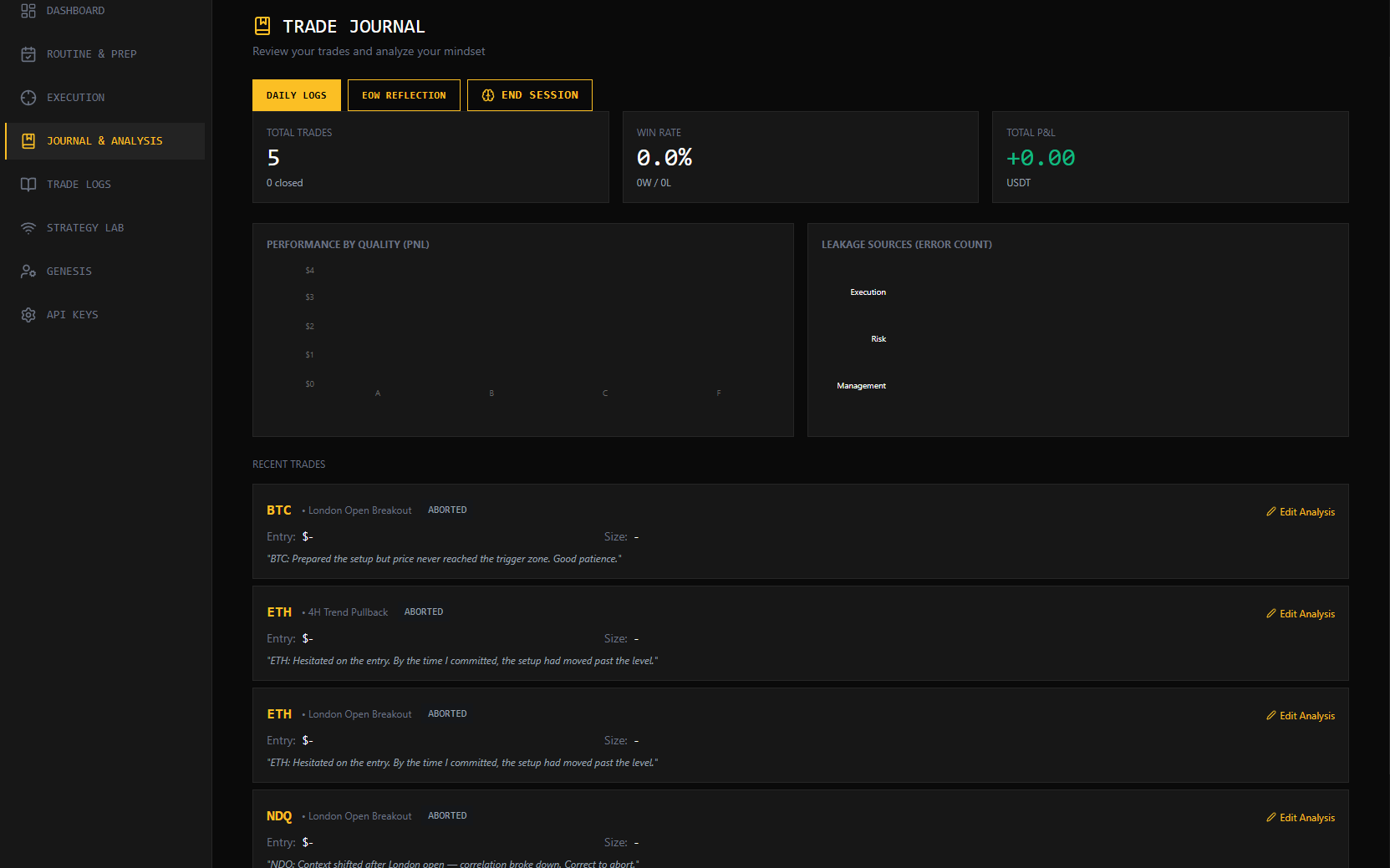
Every trade logged at close. Including ABORTED trades.
ABORTED is a first-class trade type. "Prepared the setup but price never reached the trigger zone. Good patience." That is a win. The system logs it as discipline data — not absence of a trade. Over time, the ratio of well-executed aborts to impulsive entries tells you more about your process than your win rate does.
Leakage tracking: Execution errors, Risk errors, Management errors. Each trade tagged by where the process broke down, not just whether it made money.
The design decision that mattered
Risk limits at the database layer, not the UI layer.
Every other trading journal enforces limits client-side — a red number, a modal, a nudge. Under pressure, you dismiss it. In LYT, when the daily loss threshold is hit, the record updates in Supabase. The execution workspace re-fetches state on mount and route change. No client-side override path exists. The psychology of "I could technically still trade" is removed.
What broke
The strategy versioning system took two iterations.
First version: flat. Each strategy was one record. As the logic evolved, there was no way to compare V1 performance against V3 after a rule change. You saw a blended P&L that meant nothing.
Second version: versioned. Every rule change creates a new version. Old trades stay attached to the version they were taken under. Now V3 London Open Breakout (4.11 profit factor, 28 trades) is meaningfully comparable against V1 (0.4 profit factor, 4 trades). That difference is where the learning is.
Real numbers
| Metric | Value |
|---|---|
| Win rate | 61% |
| Trades logged | 59 |
| Profit factor | 3.98 |
| Risk score | 95/100 (System Compliant) |
| Top strategy EV | +112.98R (4H Trend Pullback, V5) |
| Top strategy Sharpe | 1.89 |
Paper mode numbers. The infrastructure is live. The behaviour being trained is real.
Architecture
- Stack: Next.js App Router, React 19, Tailwind CSS, Prisma ORM, Supabase Postgres
- Data: Binance API for real-time execution data and market context
- AI: Google Gemini for weekly performance review and EOW reflection prompts
- Auth: Supabase Auth
- Hosting: Vercel
Status
Live at logyour.trade. Free tier, $19/month for full journaling, $39/month with AI weekly review. Active development.
Personal project. Secondary to Imersian. Built evenings.
Stack: Next.js App Router · React 19 · Tailwind · Prisma · Supabase Postgres · Google Gemini · Binance API. Solo build. Ongoing.